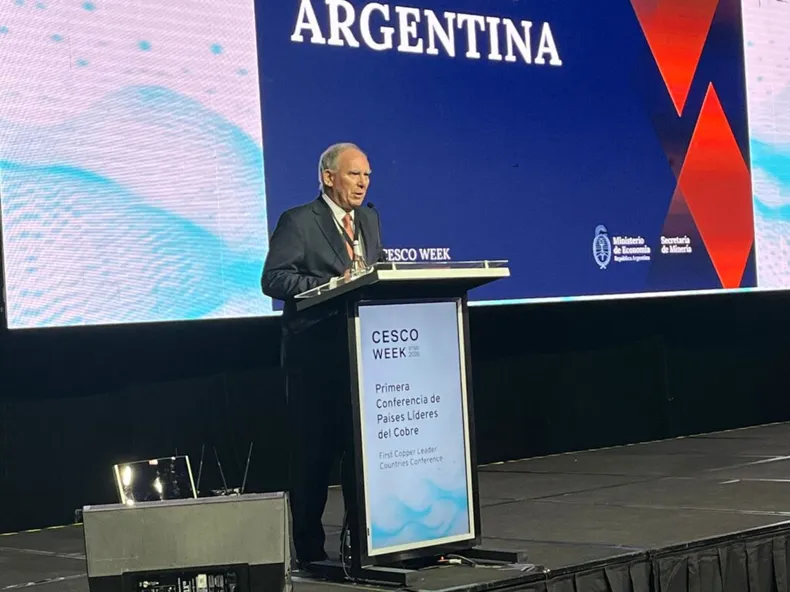
Luis Lucero: ‘Debemos ser inteligentes en esta competencia de competitividad minera'» ▶️ Luis Lucero: “We must be smart in this race for mining competitiveness”
En diálogo con el medio Cuyo Minero durante la CESCO Week en Santiago de Chile, el Secretario de Minería de la Nación argentina, Luis Lucero, reconoció que para el país se avecina una etapa de competencia y colaboración entre la región sudamericana, donde Argentina debe procurar un desarrollo para el futuro.
Cómo impactará este boom minero en las provincias y la economía del país.
¿Cuál es el balance para Argentina de la semana del cobre en Chile?
El primero vuelve a ser que el mundo está esperando más de nosotros, mirando Argentina, con un enorme interés, algo que yo vengo constatando cada vez que tengo la oportunidad de viajar. Ese interés tiene dos vertientes. La primera tiene que ver con que conoce nuestros recursos geológicos. Hoy estuve en un evento de litio y ya es una realidad que el mundo está poniendo muchas expectativas en cómo está creciendo la producción, y mientras Chile está estancado en la misma cantidad de proyectos, en Argentina está creciendo y eso genera impacto. Después estuve en un evento sobre cobre y creo que, por primera vez en mucho tiempo, Chile mira a Argentina tanto como un potencial socio como un posible competidor. Aparecen las dos palabras.
Argentina frente a Chile y Perú: Hacia una ‘competencia coordinada’
¿Cómo se espera que sea a futuro esta relación con Chile?
Tiene que haber una competencia coordinada, hay algunas ideas que obviamente deben ser meditadas por nosotros muy cuidadosamente. Empieza a aparecer la noción de un polo, como existe el triángulo del litio pero esta vez del cobre, con Perú, Chile y Argentina. Pero los dos países vecinos tienen una producción de cobre fuerte desde hace mucho tiempo y nosotros estamos por empezar.
¿Qué cuidados debe tener Argentina en este escenario?
Por ejemplo, en el tema de proveedores, por supuesto. El esfuerzo que estamos haciendo es para ser aprovechado en principio por argentinos. Pero tenemos que ir buscando un equilibrio en el cual todos ganemos. Primero, porque vivimos en un país libre en el cual las empresas tienen la oportunidad, la facilidad y el derecho de elegir a sus propios proveedores Por otro lado, tenemos las limitaciones del RIGI y las regulaciones provinciales, sobre todo respecto a mano de obra local.
Por otra parte, sabemos que es del interés de los proyectos y de las provincias y del sector en su totalidad, que se mantenga la licencia social y esta se gana empezando por las comunidades cercanas al proyecto y siguiendo por la provincia que lo aloja, cuando reciben lo que puede ser considerado una cuota razonable de los beneficios del proyecto.
El despertar de la minería argentina: Entre el interés global y los desafíos de infraestructura
¿Qué factores influyen para que haya un aprovechamiento local?
Es un delicado equilibrio, porque va a haber cosas que en el país no podamos proveer, de cierta tecnología o cierto expertise, pero hay cosas que sí son posibles. Tenemos que ser equilibrados a la hora de fijar precios y debemos ser un país abierto internamente. Es importante que esté la capacidad de los trabajadores de moverse de un sitio a otro buscando donde haya trabajo y oportunidades, así se hizo grande el país, y creo que a eso tenemos que ir.
Debemos ser conscientes de que Chile y Perú tienen expectativas al ver cuánto va a crecer la industria en los próximos dos a ocho años y teniendo en cuenta que Argentina no va a dar abasto en algunos aspectos. Pero hay que tener en cuenta que en otros sí va a ser capaz y lo será de sobra. Se trata de un problema, pero uno positivo, porque es de crecimiento.
¿También puede haber medidas en la región para competir con el RIGI?
En la competitividad, entre otras razones y causas, está también el factor tributario. Esto es importante que lo entendamos, sobre todo porque hay sectores todavía muy amplios de la sociedad que insisten con que la minería no deja nada o que las regalías son bajas. Nos ha costado mucho esfuerzo ponernos competitivos a nivel internacional.
Si Chile o Perú emprenden el mismo camino no me extrañaría nada, sería razonable que lo hagan porque tienen otros condicionamientos, por ejemplo yacimientos con bajas leyes y por eso deben ser competitivos. Nosotros también debemos serlo.
¿Qué puede hacer Argentina frente a esto?
Debemos ser inteligentes, yo llamaría esto una competencia de competitividad.
El RIGI ha tenido cambios, para hacerlo más flexible y abarcar más proyectos. ¿Puede haber una nueva extensión?
La prórroga hasta 2027 que se definió por decreto estaba prevista en la ley. ¿Es imposible cambiar la norma para extenderlo? No lo creo, pero es un trabajo que tiene que hacer el Congreso de la Nación.
¿Esto depende de los resultados de la industria?
No, no veo que vaya a haber un juego en este sentido, porque los proyectos van a ir avanzando según la etapa en la que están. Es decir, van a ir aumentando su exploración o construyendo alguna infraestructura. Pero no veo proyectos entrando en construcción hasta el próximo año, que es cuando termina el régimen.
¿Cómo avanza la puesta a punto de infraestructura para el sector, en especial el tren (Belgrano Cargas) ?
Tengo entendido por diálogos internos que tuve en los últimos días con funcionarios que en breve estarán los pliegos de licitación para el Belgrano Cargas. Esto va a ser un enorme avance, porque los dos ramales alimentarán directamente los proyectos de cobre del oeste y los proyectos de litio en el Noroeste, así que es una salida logística muy importante.
Fuente: Cuyo Minero
In an interview with Cuyo Minero during CESCO Week in Santiago de Chile, Argentina’s Secretary of Mining, Luis Lucero, acknowledged that the country is entering a phase of competition and collaboration within the South American region, where Argentina must strive for future development. How will this mining boom impact the provinces and the country’s economy?
What is Argentina’s takeaway from Copper Week in Chile?
First and foremost, the world is expecting more from us, looking at Argentina with enormous interest—something I’ve observed every time I have the opportunity to travel. That interest has two aspects. The first has to do with the fact that they are aware of our geological resources. Today I attended a lithium event, and it is already a reality that the world has high expectations regarding how production is growing; while Chile is stagnating at the same number of projects, Argentina is growing, and that is making an impact. Later, I attended a copper event, and I believe that, for the first time in a long time, Chile views Argentina as much a potential partner as a possible competitor. Both terms are being used.
Argentina vs. Chile and Peru: Toward “Coordinated Competition”
What do you expect this relationship with Chile to look like in the future?
There needs to be coordinated competition; there are some ideas that we obviously need to consider very carefully. The concept of a hub is beginning to emerge—similar to the “lithium triangle,” but this time for copper, involving Peru, Chile, and Argentina. However, our two neighboring countries have had strong copper production for a long time, while we are just getting started.
What precautions should Argentina take in this scenario?
For example, regarding suppliers, of course. The effort we are making is intended to benefit Argentines first and foremost. But we must seek a balance in which everyone wins. First, because we live in a free country where companies have the opportunity, the freedom, and the right to choose their own suppliers. On the other hand, we face the limitations of the RIGI and provincial regulations, especially regarding local labor.
Furthermore, we know that it is in the interest of the projects, the provinces, and the sector as a whole to maintain social acceptance, and this is earned by starting with the communities near the project and extending to the province that hosts it, when they receive what can be considered a reasonable share of the project’s benefits.
The Resurgence of Argentine Mining: Between Global Interest and Infrastructure Challenges
What factors influence local utilization?
It’s a delicate balance, because there will be things we can’t provide domestically—certain technologies or expertise—but there are things that are indeed possible. We have to strike a balance when setting prices, and we must be an internally open country. It’s important that workers have the ability to move from one place to another in search of work and opportunities; that’s how the country grew, and I believe that’s the direction we need to head in.
We must be aware that Chile and Peru have expectations regarding how much the industry will grow over the next two to eight years, and bearing in mind that Argentina will not be able to keep up in some areas. But we must also keep in mind that in other areas, it will be capable—and more than capable. It is a problem, but a positive one, because it is about growth.
Could there also be measures in the region to compete with the RIGI?
When it comes to competitiveness, among other reasons and factors, there is also the tax factor. It is important that we understand this, especially because there are still very large sectors of society that insist that mining leaves nothing behind or that royalties are low. It has taken us a great deal of effort to become competitive on an international level.
If Chile or Peru were to follow the same path, I wouldn’t be surprised at all; it would be reasonable for them to do so because they face different constraints, such as low-grade deposits, and therefore must be competitive. We must be competitive as well.
What can Argentina do about this?
We need to be smart; I would call this a race for competitiveness.
The RIGI has undergone changes to make it more flexible and cover more projects. Could there be a new extension?
The extension until 2027, which was established by decree, was provided for in the law. Is it impossible to change the law to extend it? I don’t think so, but that’s a job for the National Congress.
Does this depend on the industry’s results?
No, I don’t see this becoming an issue, because the projects will move forward according to the stage they’re in. That is, they’ll increase exploration or build infrastructure. But I don’t see projects entering construction until next year, which is when the program ends.
How is the infrastructure development for the sector progressing, especially the Belgrano Cargas railway?
I understand from internal discussions I’ve had in recent days with officials that the bidding documents for Belgrano Cargas will be available shortly. This will be a huge step forward, because the two branches will directly serve the copper projects in the west and the lithium projects in the northwest, so it’s a very important logistical solution.
Source: Cuyo Minero
Descubre más desde Lithium Triangle South America -News
Suscríbete y recibe las últimas entradas en tu correo electrónico.