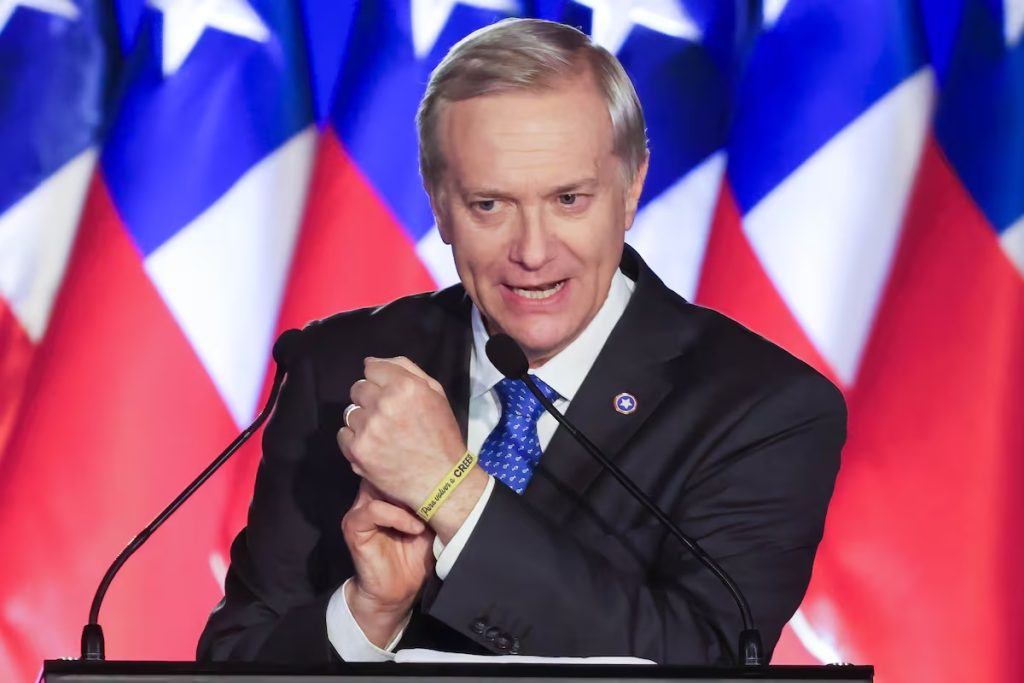
Primera semana de Kast como presidente electo de Chile: tres aspectos que podrían marcar su gestión ▶️ Kast’s first week as Chile’s president-elect: three aspects that could shape his administration
A ocho días de la elección presidencial, el analista del Centro de Opinión Pública y Democracia de la Universidad Central (UCEN), Marco Moreno, analizó la primera semana de José Antonio Kast como presidente electo, destacando tres aspectos que podrían dar luces de cómo será su gobierno.
En conversación con el Expreso Bío Bío, el analista político explicó que el líder republicano ha intentado “recalibrar las expectativas”.
“Recordemos que ganó la elección con una inflación de expectativas, la gente cree que se van a resolver todos los problemas. Por lo tanto, lo que ha hecho el presidente electo, en varios momentos, como el discurso el domingo en la noche, cuando ganó la elección, después la reunión con el Presidente Gabriel Boric, y en otros distintos momentos, ha intentado introducir esta idea de moderación y de gradualidad”, agregó.
En ese sentido, según Moreno, el mensaje que busca instalar Kast es que “las cosas se van a hacer, pero evidentemente se requiere el apoyo, se requiere el concurso de todos para poder avanzar en este desafío”.
Por otra parte, el director del Centro Opinión Pública y Democracia apuntó a que el republicano ha tomado el control de la agenda tras crear la Oficina del Presidente Electo (OPE).
“Estamos hablando de una estructura. Aquí hay equipos, tiene sede propia, están revisando las cuestiones programáticas y también están haciendo el reclutamiento de quienes van a ser los que asuman funciones, tanto a nivel ministerial y de los equipos de gobierno”, dijo.
En tercer lugar, dentro de lo siete primeros días de Kast como presidente electo, Moreno destacó lo que denominó como “la gestión simbólica del poder”.
“El presidente electo todavía no asume sus funciones, sino que es a partir del 11 de marzo. Sin embargo, ha dado varias señales de que él es la autoridad. Primero, el viaje a Argentina el día martes pasado; la reunión con el presidente (Javier) Milei, de igual a igual, con un presidente con quien tiene ideas afines”, explicó.
De todas maneras, sostuvo que “resultó bastante bien la visita, salvo por la foto con la motosierra, que, incluso dentro de su propio equipo, la consideraron innecesaria, porque justamente el presidente tiene que recalificar las expectativas y eso significa buscar acuerdos de entendimiento, entre otras cosas, con quienes van a ser la oposición a partir del 11 de marzo. Probablemente, esa imagen de la motosierra lo vincula un poco, más bien, a la radicalidad, a cambios que pueden ir en contra de lo que la gente hoy día quiere”.
En esa línea, Moreno planteó que “dentro de esa gestión simbólica del poder, el segundo hecho es esta idea de que el presidente va a vivir en el Palacio de La Moneda”.
“Aquí está lo performático, el presidente anuncia que va a vivir en La Moneda, que no solamente es una narrativa de austeridad, también de orden, y sobre todo en un clima de mucha desconfianza de la gente hacia los políticos. Alguien que dice ‘yo no solamente me voy a preocupar, sino que me voy a ocupar de los problemas, voy a estar 7 días instalado acá»”, añadió.
De esta forma, el analista político señaló que Kast “centraliza el poder, más que delegar el poder; el poder está centrado en el presidente. Eso puede tener virtudes, pero también puede tener riesgos. Si las cosas no andan bien, la crítica va a estar muy centrada en el presidente. Pero son los riesgos que está adoptando el presidente electo”.
Fuente: BioBio Chile : Reajuste de expectativas y gestión simbólica del poder: primera semana de Kast como presidente electo
Eight days after the presidential election in Chile, Marco Moreno, an analyst at the Centre for Public Opinion and Democracy at the Central University (UCEN), analysed José Antonio Kast’s first week as president-elect, highlighting three aspects that could shed light on what his government will be like.
In conversation with El Expreso Bío Bío, the political analyst explained that the Republican leader has attempted to ‘recalibrate expectations.’
‘Let’s remember that he won the election with inflated expectations; people believe that all problems will be solved. Therefore, what the president-elect has done, on several occasions, such as in his speech on Sunday night when he won the election, then in his meeting with President Gabriel Boric, and at other times, is to try to introduce this idea of moderation and gradualism,’ he added.
In that sense, according to Moreno, the message that Kast is seeking to convey is that ‘things will be done, but obviously support is needed, everyone’s cooperation is needed to move forward with this challenge.’
On the other hand, the director of the Centre for Public Opinion and Democracy pointed out that the Republican has taken control of the agenda after creating the Office of the President-elect (OPE).
‘We are talking about a structure. There are teams here, it has its own headquarters, they are reviewing programme issues and they are also recruiting those who will take on roles, both at ministerial level and in government teams,’ he said.
Thirdly, within Kast’s first seven days as president-elect, Moreno highlighted what he called ‘the symbolic management of power’.
‘The president-elect has not yet taken office, but will do so on 11 March. However, he has given several signs that he is the authority. First, the trip to Argentina last Tuesday; the meeting with President (Javier) Milei, as equals, with a president with whom he has similar ideas,’ he explained.
In any case, he maintained that «the visit went quite well, except for the photo with the chainsaw, which even his own team considered unnecessary, because the president has to recalibrate expectations, and that means seeking agreements, among other things, with those who will be the opposition after 11 March. Probably, that image of the chainsaw links him a little more to radicalism, to changes that may go against what people want today.»
Along these lines, Moreno suggested that ‘within that symbolic management of power, the second fact is this idea that the president is going to live in the La Moneda Palace.’
‘Here’s the performance aspect: the president announces that he is going to live in La Moneda, which is not only a narrative of austerity, but also of order, and above all in a climate of great mistrust of politicians among the people. Someone who says, “I’m not only going to worry about the problems, I’m going to take care of them, I’m going to be here seven days a week,”’ he added.
In this way, the political analyst pointed out that Kast ‘centralises power, rather than delegating it; power is centred on the president. That can have virtues, but it can also have risks. If things don’t go well, criticism will be very focused on the president. But these are the risks that the president-elect is taking.’
Source: BioBio Chile :Reajuste de expectativas y gestión simbólica del poder: primera semana de Kast como presidente electo
Descubre más desde Lithium Triangle South America -News
Suscríbete y recibe las últimas entradas en tu correo electrónico.